|
|
All
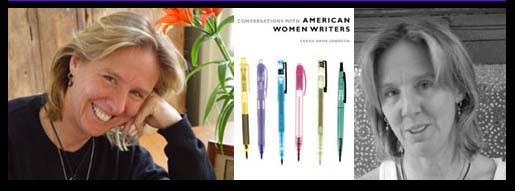
photos by Lou Lumorno © 2003
Reader’s
Group Guide
Discussion
Questions &
Interview with Sarah Anne Johnson
Download the Reader's Group Guide
Discussion Questions For Conversations
with American Women Writers
1. Johnson includes a
quote by Eudora Welty at the beginning of the book.
Why do you think she chose this particular epigraph?
Of the authors Johnson has interviewed, who do you
see as “a writer who came from a sheltered
life”? What does Eudora Welty mean when she
declares, “A sheltered life can be a daring life
as well. For all serious daring starts from
within”?
2. There’s an element of playfulness in Aimee
Bender’s writing that is reflected in the
descriptions of her writing process. Like Elizabeth
Cox, who enjoys “not knowing where it’s
going” (p.p.47) when she’s working on a
first draft, Bender’s freedom of imagination
comes through in her magical prose. How do these
writers’ creative processes illuminate their
work? Of the writers you’ve read, whose
process—of coming up with ideas, of
revising—is particularly interesting, or
surprising, or obvious? Were there writers whose
answers reminded you of their writing style? What
does this tell you about how much personality informs
an author’s prose?
3. A memorable line from every writer has been culled
to serve as a title for each interview. Many of these
phrases betray a natural lyricism or profundity, such
as Elizabeth McCracken’s “You Must Be
Prepared to Break Your Own Heart.” What do you
think McCracken is getting at with this remark? What
does she mean when she says, “Most of my advice
has to do with preparing yourself for depression and
heartbreak in the actual writing of the book”?
What do you make of the strong bond a writer has for
her work? What else did you notice about these
chapter headings? Why do you think these particular
quotes were chosen?
4. Many of these women mention emotion and intuition
when describing the act of writing. Maria Flook
confesses, “My first impulse is less an
intellectual germ than a psychological or even
emotional tempest or affliction” (p.p.72), and
that her work, “begins with a gnawing or pecking
in the gut” (p.73). Similarly, Lois-Ann Yamanaka
tells Johnson, “When I hit that last period on
the manuscript, I stop, I lean back, I start
crying” (p.219). How do these descriptions alter
the perception that writing is primarily an
intellectual art form? How do emotion and intuition
contribute to the writing process? How do you think
the reader’s emotional connection to a book
differs from the writer’s?
5.Of the authors interviewed in the book whom you
haven’t read, which ones stand out as writers
whose work you’d like to explore in the future?
Why?
6. A few of the writers here could be labeled as
historical novelists. Andrea Barrett is such a
writer, and she says she included women in her story
The Voyage of Narwhal because she didn’t want to
write “the nineteenth-century version of
it” (p.13). Similarly, when Nora Okja Keller
wrote Comfort Woman, she had to tell the story of
women who in previous histories had barely existed at
all. Through reading these interviews, what do you
understand to be the role of the historical fiction
writer, and how does she help us to understand
factual history? How do these women retell, or
revise, history to include the previously excluded?
Do these projects prove, as Jayne Anne Phillips says,
that “writing is very political” (p.193)?
7. There are many sources of inspiration for the
writers in this collection. Elizabeth Cox mentions
listening to symphonies and sonatas while writing her
first novel, Familiar Ground; Chitra Banerjee
Divakaruni says she gets ideas from eavesdropping on
the conversations of strangers; and Sena Jeter
Naslund says Ahab’s Wife began when
“Suddenly, I had a vision and I heard a
voice” (p.158). Confessions of magic and mystery
run through all of the interviews, no matter how
diverse the authors are. Does the knowledge of an
author’s inspiration alter how a book is read
and thought about? Is there a similar type of
inexplicable magic that occurs when reading fiction?
8. Amy Bloom and Lynn Freed are fans of Jane Austen,
and Nora Okja Keller and Lois-Ann Yamanaka cite the
importance of Maxine Hong Kingston’s Woman
Warrior. Other women writers are mentioned multiple
times, such as the Canadian short story writer Alice
Munro, and the seminal Southern author, Flannery
O’Connor. After reading this collection, do you
think these authors feel part of a strong tradition
of American women writers? Can you predict how any of
the writers here might influence future women
novelists? Does this make you want to read more
classic female authors?
9. For a collection of interviews, it’s
interesting that Johnson has titled her book
Conversations with American Women Writers. Did
Johnson’s interviews feel natural and personal,
perhaps even reciprocal, as conversations do? Were
any of her questions especially helpful to you in
understanding a writer’s work? Was there
anything she didn’t ask an author that you would
have? Do you now feel what Johnson describes in her
introduction as “a connection” (p.xiv) with
any of these writers?
10. What can be gained from reading interviews that
are “representative of the diversity of writers
working today” (p.xiv)? What does this varied
cross section of American women writers tell us about
contemporary American literature? How does
Johnson’s goal to speak with writers who
“cross boundaries of race, religion, ethnicity,
geography, sexual preference, and education”
(p.xiv) affect the way she leads each interview? Do
you think she led some interviews differently than
others? If so, how and why?
An Interview Sarah Anne
Johnson,
Author of Conversations with American Women Writers
Were you a
reader of author interviews before you started
conducting them yourself? If so, why did you read
them? As a reader, what do you look for in an
interview? I started reading author
interviews over fifteen years ago when I was still in
college, because I was fascinated to hear writers
talk about their work. I felt like I was listening in
on a private conversation and it was addictive. I
discovered the Writers at Work series (p.put out by
the Paris Review) in a used bookstore and was
thrilled to find Women Writers at Work because I
identified more with the experiences of those
writers. I was writing in an isolated context, and I
found companionship, inspiration and validation in
the interviews. It was also captivating to hear the
voices of the writers talking about why characters
acted as they did, why they chose a particular
setting for a beloved story, and so on.
As a reader, I want an interview to reveal both the
writer and things about a book I might not otherwise
know. For example, learning that Ahab’s Wife
came to the author, Sena Jeter Naslund in a voice
speaking the first sentence: “Ahab with neither
my first husband nor my last.” Naslund also
revealed to me why she included women from history
such as Margaret Fuller to make the existence of her
independent female main character, Una, more
credible. After reading Maria Flook’s memoir My
Sister Life: The Story of my Sister’s
Disappearance I was dying to know how she created the
chapters from her sister’s point of view, and in
my interview with her, she reveals how this aspect of
her memoir works. As a writer, I want to learn about
craft and hear how other writers face various
challenges and why they make the decisions they do. I
want to hear about hard they worked to achieve
success, and how they finally made it.
How did you come to conduct your first
interview? In what ways did the experience of
conducting an interview match your expectations? In
what ways did the experience surprise you? I
became interested in interviewing authors because
after reading interviews I always had questions that
weren’t addressed in the interview. I often felt
that I could do a better job, or at least conduct an
interview that would satisfy my own curiosities. I
did my first interview as an MFA student in the
Bennington Writing Seminars in 1999. After studying
with Lynn Freed, I read all of her books and began to
notice through each novel the development of her
craft as a writer, and the themes that she returned
to again and again. Because I’d studied with
her, I had insight into her thinking and what was
going on in her work. It was the pressure of these
real questions building within me that drove me to
engage her in an author interview. I’m not sure
what I expected going in, only that I wanted to be
more than adequately prepared and not sound stupid.
What surprised me was how much fun the interview was
and how it solidified my relationship with Lynn.
We’ve gone on to do other interviews together
and she arranged to have my interview with her in the
readers’ guide for her novel House of Women. I
was surprised at how much people enjoyed the
interview, and that inspired me to keep going.
How do you prepare for an interview? How have
your preparation methods changed as you've done more
interviews? Can you give examples of occasions when
careful preparation has paid off in particularly
surprising or satisfying ways? I do a lot of
research that includes reading all of an
author’s work both inside and outside their
usual genre. With Lynn, this meant reading her
novels, short stories that appeared in magazines and
literary journals, articles she’d written,
articles about her, and interviews with her. I
immerse myself in the work of an author and let the
work invade my brain. By infusing myself with the
author’s work, the questions flow organically.
As I’ve done more interviews, my reading and
research has become more focused. I know more what
will make for evocative questions, and I recognize
more easily issues that I want to pursue in the
conversation. The research always pays off. The
unexpected aspect of this is how it relaxes the
writers. They’re so used to being interviewed by
journalists who haven’t read their work or who
aren’t well prepared, that if I do my homework
and demonstrate a real interest in their work by
asking intelligent questions, they truly appreciate
it. My preparation and interest allows them to relax
and enjoy the conversation and they’re more
likely to open up.
Is it difficult to secure the cooperation of
the writers you want to interview? Have you ever been
turned down? What sorts of concerns or expectations
do the writers typically bring to the interview? What
techniques have you developed to put them at their
ease or to reassure them about the process?
It hasn’t been difficult to secure interviews.
So far, the only people who’ve said no are those
either in the throes of finishing a project, or those
who just won’t do interviews, such as Alice
Monroe and Annie Proulx. I query them every now and
again in the hopes that they’ll say yes. I
don’t’ take it personally if an author is
unavailable. I go to the next author on my list. Most
writers have to do interviews in order to promote
their work, and because I’ve been publishing
interviews on a regular basis and have affiliations
with magazines such as The Writer and The
Writer’s Chronicle, the publicists usually push
the interview through because they know it will get
into print.
I think that writers come to interviews like anyone
else, afraid of sounding stupid, being misquoted or
being asked personal questions they don’t want
to answer; an interviewer who hasn’t prepared is
more likely to represent the author poorly. I let the
author know ahead of time that they’re being
taped and that they’ll be able to see the
interview and tighten up language and make
clarifications before it’s published, which they
find reassuring. Writers aren’t public speakers.
They’re used to having years to work on a piece
of writing, and the interview format can be
intimidating, even to those who are used to it.
I’ve found that the thing that puts writers most
at ease is asking thought-provoking, intelligent
questions.
Can you comment on the logistics of
interviews: setting, tape vs. notes, formal vs.
informal, follow-up, etc. What are your own
preferences? Do the subjects themselves ever have
preferences on these issues? To what extent are
authors likely to set "ground rules" of
various kinds?
If I can meet with an author in person, I do
because there’s a degree of kinship to be gained
in meeting face to face, though often this isn’t
possible because of geography. I always go into an
interview with a comprehensive list of questions. I
tape record the interview so that I can relax and be
present to the conversation. Over time, I’ve
come to prefer the telephone interview because
I’m more relaxed in my own home and the authors
have been, too. Imagine the author sitting at home
with a cup of tea and talking freely on the phone.
Email interviews can work well if you do it right and
some authors will only do email interviews. The Lynn
Freed interview in this book is the only one
conducted by email. We achieved a conversational feel
by passing it back and forth. First I sent her a long
list of questions, which she answered and sent back
to me. In reading through her responses, I inserted
more questions and sent it back again. We went on
like this until we were done. The only “ground
rules” I’ve encountered were when I visited
an author in her home and she asked that I not
describe her home in the interview. That wasn’t
something I was interested in anyways, so it
didn’t inhibit the interview at all. It was
fine.
How do you maintain a balance between
following the questions that you have prepared in
advance and following the flow or logic of the
discussion? Do you ever find the interview going off
in a surprising direction? Is it sometimes necessary
to reassert control over the direction of the
interview, and if so, when and how do you do so?
I view my list of questions as a road map. I
might get off course and follow many winding roads
off to the side, but when a line of dialogue reaches
it natural conclusion, I return to the map and ask
the next question on the list. Often a single
response will answer several questions, and in this
case I just work my way down the list. I don’t
feel the need to assert control over the interview.
If the author wants to run on, I let them talk
because I’m generally in no rush. I want to hear
everything they have to say. If I was doing the
interviews on a radio show or on some other specific
format, then I’d have to assert myself more, but
in this sort of interview, the more material you can
get in your conversation, the better. As far as
surprising directions interviews have taken, the
first thing that comes to mind was when I interviewed
Sena Jeter Naslund, she was so candid about her early
years of trying to master her craft. She was intent
on sharing how difficult it was for her to learn to
write fiction, and I found her openness surprising
given the success of her recent novels. Often people
don’t want to admit that they were ever
struggling artists, but hearing how hard it was from
someone so successful was very inspiring to me. And
then, in a more general sense, I was surprised and
pleased by the consistent generosity of the writers
in sharing the inner-workings of their writing lives,
in taking time away from their work to submit
themselves to an interview.
How do the interviews that are collected in
your book differ from the more journalistic
interviews that a reader might see in the newspaper?
How is the experience of the two types different for
the reader? For the subject? For the interviewer?
The interviews in Conversations with
American Women Writers are not limited in length
and so they explore the writer and their work with
more depth and scope. Newspaper interviews are
usually limited by a strict word count, and often
journalists are overworked and don’t have time
to do the kind of preparation required to conduct an
in-depth interview. Newspaper interviews are light
and often tie the book or author into a current event
or local angle. My interviews seek to inform readers
about the inner-workings of the writer’s process
and to add insight into the books readers love. The
interviews in Conversations seek to engage readers
more deeply and draw them into the author’s
work, or if they’ve all ready enjoyed the
author’s work, the interview will provide
insights that the reader didn’t previously have.
These interviews will be great companions to book
discussion groups in that they reveal the writer and
aspects of their work that a reader could not
otherwise know.
In the introduction to your book, you
describe author interviews and other forms of
literary journalism as aspects of building a
"writing life." Can you elaborate on this?
What sorts of benefits accrue to the interviewer in
this process?
Building a literary life is critical for a writer to
sustain any kind of writing life. If you attend an
MFA program, your literary life is created for you.
You have mentors, colleagues, community, stimulation,
structure, deadlines, and real work to be involved
in. Often upon leaving a writing program, writers
experience the “six month slump” which is a
bout of depression when faced with having to write
without the support of the program. If a writer
hasn’t attended an MFA program, they generally
hunger for some kind of community or context in which
to work. Through interviewing authors, I’ve been
able to recreate for myself that context: a literary
life like the my writing program provided. I’m
constantly meeting writers who serve as mentors
through our conversation and work on the interview,
I’m immersed in critical study that informs and
fuels my creative work, I build relationships with
editors, and I publish interviews and get feedback on
my work. In addition to the fulfillment of the work
itself, I enjoy being a character out in the world,
and find that this work, rather than taking away from
creative writing, supports and sustains it in ways I
couldn’t have imagined prior to getting involved
in it.
Another aspect to building a literary life occurs
through publishing. You never know who’s out
there reading your work and taking notice. I’ve
landed a job, been offered teaching gigs, and met
influential people in the literary world because
they’d seen my interviews in The Writer’s
Chronicle and The Writer.
You also offer workshops in "how to
conduct an author interview." Can you describe
these workshops? Who attends them and with what sorts
of goals and expectations? The workshop is
called The Art of the Author Interview and
it teaches the nuts and bolts of conducting
interviews, from making contact with the writer and
doing the research to composing the questions and
conducting the interview, to transcribing, editing
and publishing a finished piece. In addition, the
workshop focuses on how to use each phase of the
interview process to help build a literary life. I
find that students walk away as enthused about
building their literary lives as they are about
contacting an author for an interview. I’ve had
all kinds of students that include writers,
journalists, radio talk-show hosts, social workers
who are active readers and want to get more involved
in the literary arts, writers working on projects
that require interviewing various characters.
I’ve had students interested in interviewing
artists in other fields such as directors,
screenwriters, songwriters, visual artists,
playwrights, and so on. Students expect to learn
about conducting the interview, and are surprised to
learn that there’s so much more opportunity
available to them through this work. They come in
feeling both that an interview is an easy thing, and
at the same time, afraid to go out and get started,
or if they’ve already been doing interviews,
they want to improve their skills. They leave feeling
like they have a handle on what to do to generate a
provocative interview and how to deal with the normal
set of nerves one experiences sitting across from an
admired writer. The students I’ve had who want
to publish, are publishing. It’s very gratifying
for me to see and I think it’s important that
there are more people doing this critical work of
interviewing authors in a more thoughtful way.
Aren’t you afraid that by giving away
your secrets, you’re creating competition for
yourself?
I hope to create competition for myself because that
will drive me to improve and deepen my own work. At
the same time, I believe that there’s room
enough for everyone to do in-depth author interviews.
We are each distinct individuals and will bring our
own idiosyncrasies to the work, and there are
countless authors at work today and so few real
enthusiasts doing the interviews. The interviews in
The Paris Review continue to be the most interesting
and richest. I also feel so inspired by the benefits
I’ve enjoyed through interviewing that I want to
share these advantages with other writers, and in
fact, sharing the benefits with other writers has
become one of the joys of this work.
Recent years have seen tremendous growth in
the number of book discussion groups, author
readings, and similar activities available to
booklovers. Do you see a growing interest in author
interviews among average readers as part of this
trend?
I’m amazed at the interest in authors
and author interviews. Because of Oprah’s Book
Club and the plethora of book clubs on commercial
television (p.Good Morning America, The Today Show,
Martha Stewart), average readers are reading literary
fiction and people who never read before are buying
literature in the supermarket. It’s phenomenal.
All of the morning talk shows have book clubs now and
it’s quite common for people to be in book
groups or discussing Steinbeck’s East of Eden in
the lunch line. Because of our cultural immersion in
literature, there’s more of a need than ever
before for insightful interviews that go beyond the
typical newspaper interview, which is largely based
on the writer’s press kit. Readers want to
engage more fully with what they read, and they want
author interviews that reveal the writer and the
magic of the work. I don’t think readers are
content with being talked down to, or with interviews
in which the interviewer is not prepared.
There’s a real appreciation for thoughtful work.
That’s why I encourage my students to go out
there and get interviewing and seek publication. If
they put in real effort, their work will far outshine
the average interview available to readers today.
|